
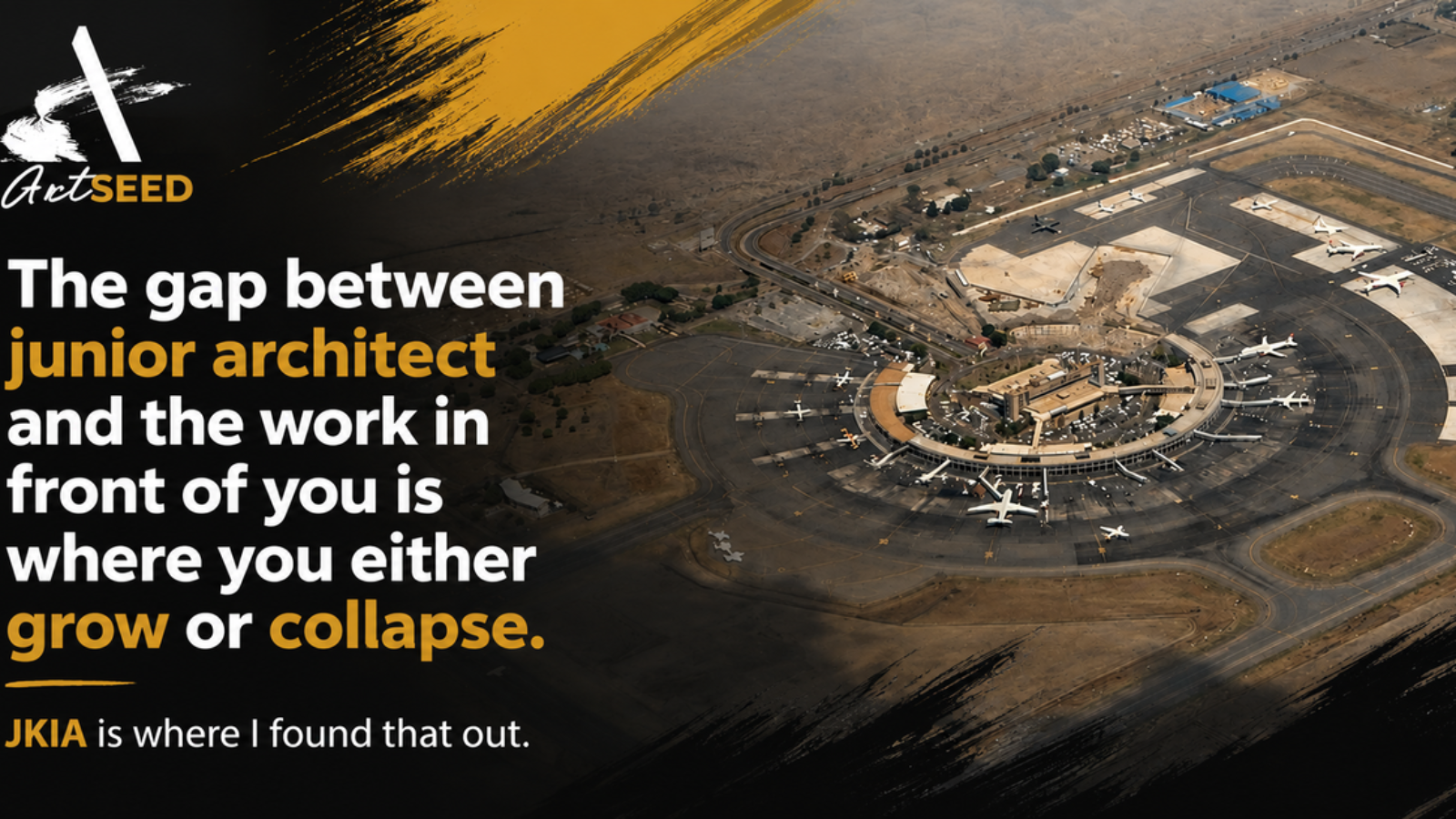
I was a junior architect on the JKIA terminal expansion. That title sounds more impressive than the reality of what it meant at the time. Junior architects are supposed to be support — you assist, you learn, you handle the smaller pieces while the senior team carries the weight.
That is not what happened.
A lot of the work fell to me. I am not saying that to sound capable in retrospect. At the time it was genuinely frightening. You are working on one of the busiest airports in East Africa, a project with real deadlines attached to real consequences, and the gap between what you know and what the project demands is enormous. There is no gradual handover. The work arrives and you either handle it or you don’t.
I handled it. But it cost me a lot of sleep to figure out how.
What JKIA Actually Teaches You
There are things you cannot learn in a classroom or on a small residential project. Scale is one of them — not just the physical scale of the building, but the scale of the coordination. At JKIA, every decision touched someone else’s work. A structural change had MEP implications. A finish specification affected the programme. A drawing issued late did not just delay one trade — it delayed a sequence of trades, and that delay compounded forward through the schedule in ways that were very hard to recover from.
You learn that fast, or you create problems for a lot of people.
Precision was the second thing. On a residential project, a minor error in a drawing gets caught, corrected, and the contractor adjusts. On a project at that scale, the same error gets reproduced across multiple sets, actioned by multiple teams, and discovered three weeks later when someone is already on site asking why something does not fit. The cost of imprecision is not one phone call. It is weeks of rectification and a conversation you do not want to have with the project manager.
Timing was the third. Deadlines at JKIA were not targets. They were commitments tied to procurement schedules, contractor mobilisation, and in some cases, operational requirements of the airport itself. Missing one did not just affect your deliverable. It affected every person downstream waiting on it. I learned that a deadline is not the day something is due. It is the day someone else’s work begins.
Accountability Has No Rank
The thing about being handed too much responsibility too early is that you cannot hide behind your title when something goes wrong. I was junior. That meant nothing when a drawing I produced had an error in it. The error was mine. The correction was mine. The explanation was mine.
That was uncomfortable. It was also the most useful thing that happened to me professionally.
A lot of architects at early career stage — and I include myself in this — carry a quiet assumption that seniority is protection. That if you do not have the title yet, you do not carry the full weight of accountability. JKIA removed that assumption completely. The project did not care what my title was. If I produced something, I owned it.
I have carried that forward. At Art Seed, there is no version of a project where the team member who produced something is shielded from the consequence of it being wrong. Not because I run a punishing environment — I don’t. But because that accountability is what keeps standards where they need to be. You sign your work, in every sense. You make sure it is right before it leaves your hands.
Precision Is Not Perfectionism
There is a version of the precision lesson that becomes paralysing if you carry it the wrong way. I have seen architects — and been that architect at certain points — who cannot release a drawing because they are still adjusting details that stopped mattering three revisions ago.
That is not what JKIA taught me. What it taught me is that precision means knowing which decisions carry risk and treating those with care, while being able to move on the decisions that don’t. A door schedule needs to be exact. The weight of a line on an early concept drawing does not. Knowing the difference is what keeps a project moving without compromising the things that matter.
At scale, you develop that instinct fast because you have to. A project like JKIA does not give you the time to be precise about everything. It forces you to triage — to understand where imprecision creates downstream problems and where it genuinely doesn’t matter yet.
That instinct is one of the most practical things I use on every project today.
What It Means for Every Project After
I run a small firm. The projects I work on now are not JKIA. They are houses, commercial builds, coastal properties, remodels — the kind of work that most people would not compare to a major airport terminal expansion.
But the principles are identical. Accountability does not scale down just because the project is smaller. Timing does not become optional because the client is an individual rather than an institution. Precision does not matter less because the building has four rooms instead of four hundred.
If anything, those principles matter more on smaller projects — because on a residential build, the client is living with every decision you made. There is no crowd of stakeholders to absorb the consequences of a bad call. It lands directly on one family, one business, one person who trusted you with something that matters to them.
JKIA taught me to take that seriously before I had the vocabulary to say why. I was too busy trying to keep up to reflect on what I was learning at the time. That reflection came later.
What project shaped how you work today?