
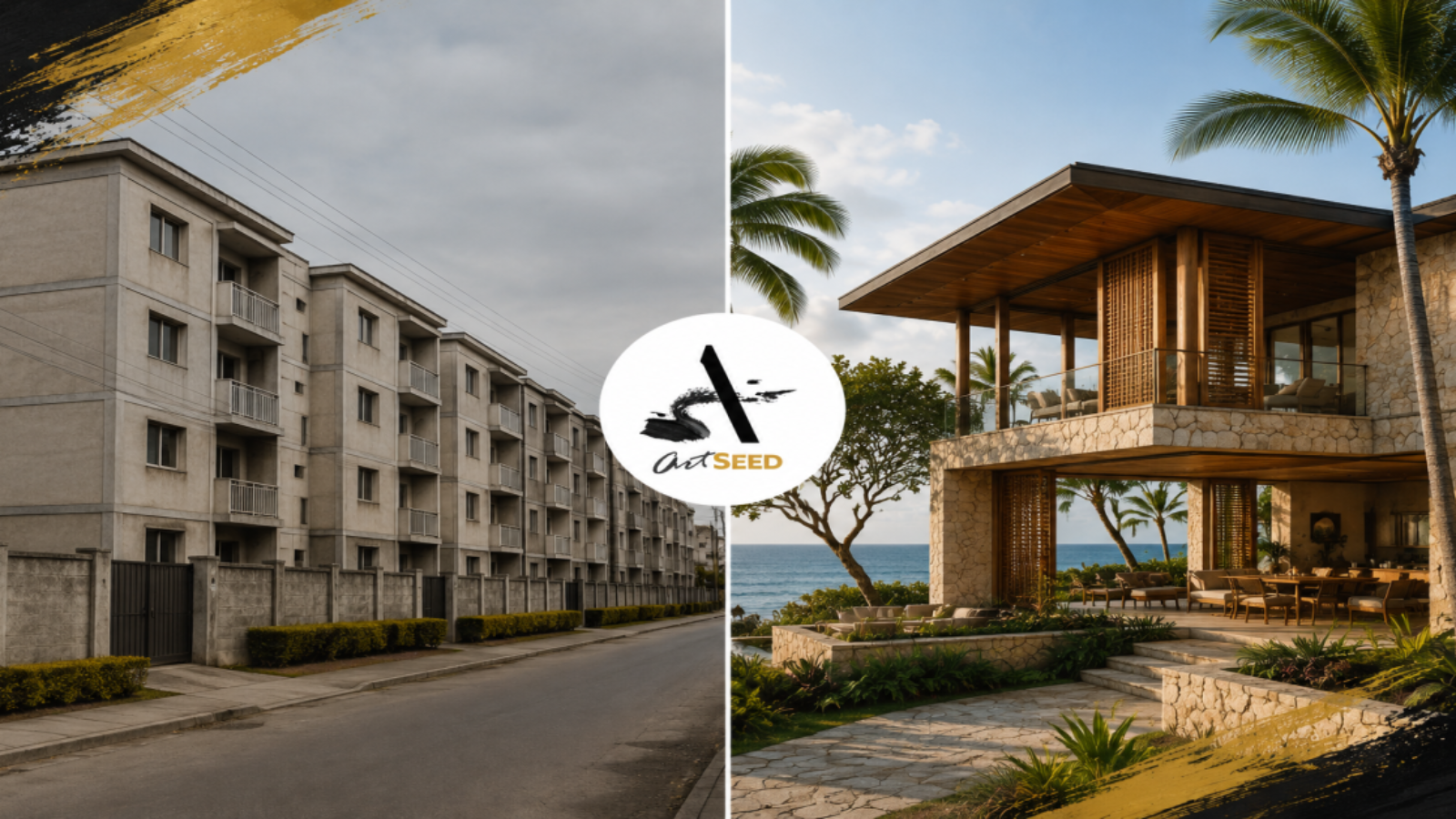
Drive through any Kenyan city. Look at the buildings.
Not the handful of landmark projects. Not the buildings that get photographed and shared. The ordinary ones — the residential developments, the commercial blocks, the apartment buildings going up on every available plot in Nairobi, Mombasa, Kisumu, Nakuru.
They look the same.
Same facade treatment. Same window proportions. Same gate design. Same compound wall with the same broken glass on top. The materials differ slightly. The colors differ slightly. The footprint shifts to fit the plot. But the building — the idea of the building, what it is trying to be — is identical across thousands of structures built in different climates, on different soils, for different people with different lives.
That is not a coincidence. It is a choice. And it is worth understanding why it keeps getting made.
Why Clients Choose Safe
I do not think most clients want boring buildings. I have never sat across from someone who said: I want something generic, something that looks exactly like the building next door, something that will be indistinguishable from every other structure on this street in ten years.
What they say instead is: I want something that works. Something proven. Something I have seen before and know will be acceptable — to my family, to my neighbors, to the bank if I ever need to finance against it, to a future buyer if I ever need to sell.
That is a rational position. Construction is expensive. Most people building in Kenya are spending money they have saved for years, or borrowed against assets they cannot afford to lose. The moment you make an unconventional choice, you introduce risk. Tthe risk that it will not work, that people will not like it, that you will have spent a significant amount of money on something that does not perform the way a safer choice would have.
So they choose safe. They point to a building they have seen and say: something like that. The architect produces something like that. The building goes up. It works. It is fine.
Fine is the problem.
What Safe Actually Costs
There is a version of the safety argument that holds. A badly executed unconventional building is worse than a well-executed conventional one. I have seen ambitious designs fail because the specification was not thought through, because the contractor did not have the skills to execute the detail, because the client changed their mind halfway through and the design could not absorb the change.
But there is a cost to safe that nobody prices in at the beginning.
A building that looks like every other building on its street has no identity. For a residential property, that means it is remembered as the house on plot number whatever, not by any quality it has. For a commercial property, it means the brand that occupies it has to work harder to differentiate itself from the signage outward, because the building itself contributes nothing to the identity. For a short-let or hospitality property — and the coast is full of these — it means competing on price rather than on experience, because there is nothing about the physical space that justifies a premium.
Standing out is not vanity. On a rental property, it is a direct line to occupancy rates and nightly pricing. A well-designed coastal property that has a distinct identity — something guests can describe and remember and recommend — commands more per night than a well-maintained generic one. That gap compounds over the lifetime of the building.
The safe choice is not always the cheap choice. It is sometimes the choice that costs you quietly, year after year, in the revenue you did not make because there was nothing to remember about what you built.
What Brave Clients Look Like
I have had a small number of clients who came in differently. Not reckless — brave is not the same as careless. They had clear briefs, real budgets, and specific ideas about what they wanted the building to do for them. What they did not have was a list of reference buildings they wanted us to copy.
They asked questions instead. What does this site want to be? What does this climate allow? What materials make sense here and why? What would make someone who visits this building remember it?
Those conversations produce different buildings than the standard brief. Not necessarily more expensive buildings — some of the most interesting design moves are not the most costly ones. A deliberate orientation that captures the coast breeze costs nothing extra in construction. A material choice that suits the environment and ages well can be cheaper than an imported alternative that deteriorates. An interior layout that connects living space to outdoor space meaningfully requires thought, not budget.
What it requires is a client who is willing to sit with the question long enough to let the answer develop. Who does not arrive at the first meeting with a reference photo and ask for that, but who engages with the design process as a process — not a procurement exercise.
Those clients are rarer than they should be. When we find them, the buildings we produce together are better. Not because we are doing something technically different, but because the brief created space for it.
The Project
A client came to us for a property on the coast. They had land, a budget, and one instruction: I do not want it to look like everything else around it.
That is a brave brief. It does not tell you what to do. It tells you what not to do, which in some ways is harder — it removes the safety net of the reference building.
We started with the site. The orientation, the prevailing breeze, the relationship between the plot and the ocean view. We looked at materials that belonged to the coast — coral stone, timber detailing, lime finishes that breathe in the humidity rather than trapping moisture behind them. We designed outdoor spaces that were part of the living sequence, not an afterthought tacked onto the back of the plan.
The building that came out of that process does not look like the buildings around it. Not because we were trying to be different for its own sake — that is a trap too. It looks different because we designed it for where it sits, for the climate it operates in, for the people who use it. Those decisions, made honestly, produced something that could not have been built on a different site in a different climate by a different client.
That is what a brave brief produces. Not a statement building. A building that is exactly what it should be in exactly the place it stands.
What Has to Change
The copycat problem is not an architect problem. Architects will design what clients ask for — and if clients keep asking for the building next door, architects will keep producing it.
The change has to start with clients who are willing to ask a different question. Not what have I seen that I liked, but what does this site, this climate, this use, this budget actually want to be? That question takes longer to answer. It requires a real conversation with an architect who is willing to push back, to propose, to defend a position when the client’s first instinct is to retreat to the safe option.
Kenya has the land, the climate, the materials, and the cultural identity to produce buildings that look like nowhere else on earth. The coast alone has a material and climatic logic that could generate a distinct architectural language — if clients were willing to trust it and architects were willing to develop it.
We are not fully there yet. But the clients who take the leap are the ones who move us closer.
Share this with a client who wants to stand out. The conversation has to start somewhere.