
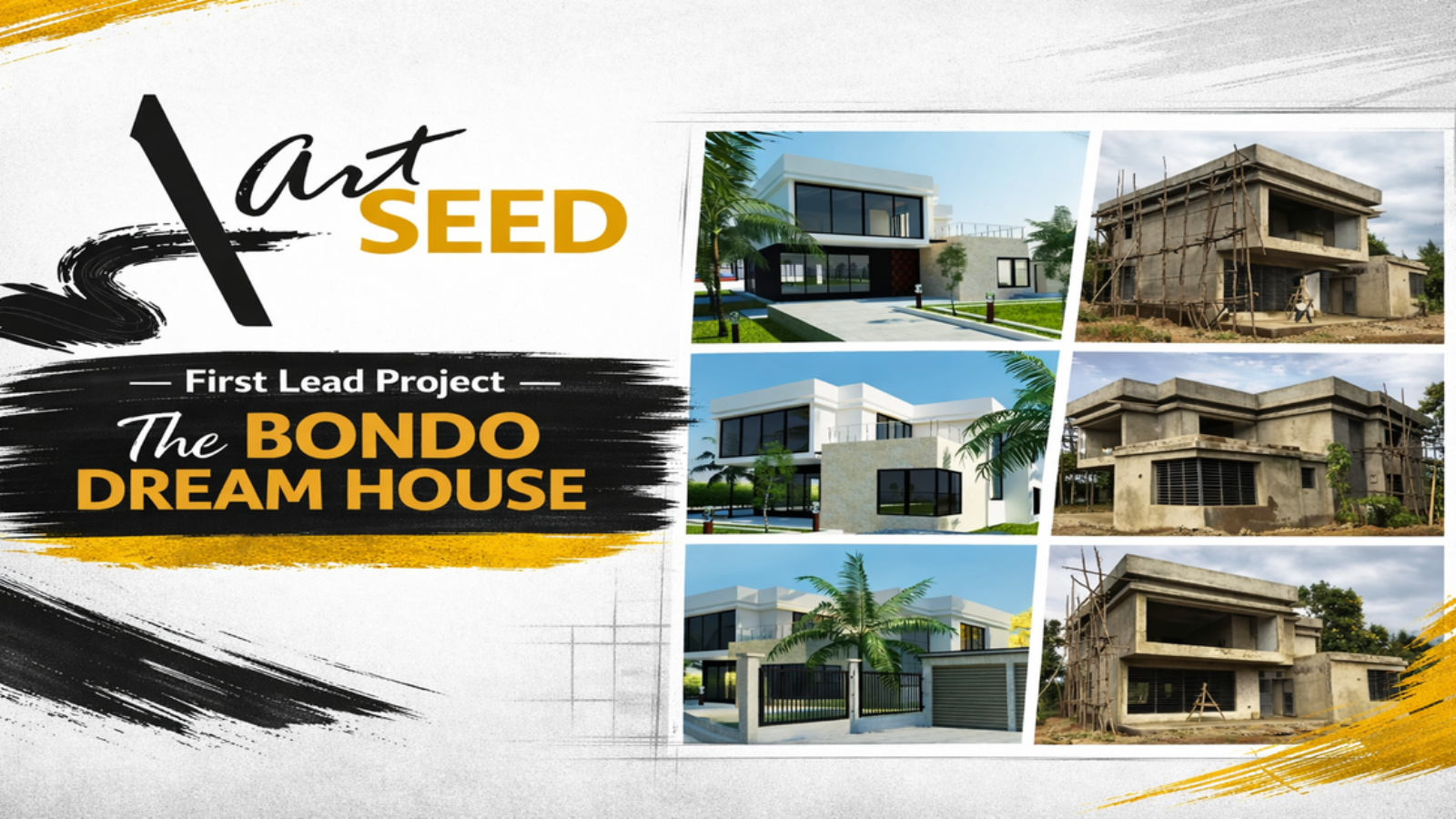
Before Bondo, I had worked on big projects.
JKIA. Two Rivers Mall. Projects at a scale that most junior architects don’t get near for the first several years of their careers. I had been handed responsibility early, and I had handled it. By the time the Bondo project came to me, I was confident. Maybe too confident.
The client was someone I had worked with at the airport. He and his wife had land in Siaya, Bondo, and they wanted to build their dream home. Not a standard three-bedroom. A home with character — cantilevers, a proper facade, landscaping. Something that would stand out.
He came to me because he had seen how I worked. He trusted me. I told him I could do it.
I could. Mostly.
What I Got Right
The design worked.
The cantilever was the centrepiece — a section of the upper floor projecting beyond the ground floor line, giving the building a bold horizontal form that most homes in that area didn’t attempt. I specified the facade carefully. The landscaping was planned from the start rather than added as an afterthought, which is still how most residential projects in Kenya treat outdoor space — as something to figure out after the building is done.
When the project was finished, people noticed it. That was the intention. A building should respond to its environment and stand out within it — not through complexity, but through confident, simple decisions made early and followed through.
The structural logic of the cantilever, the proportions of the facade, the way the building sat on its plot — these things worked because the design was thought through before a single brick was laid. That part I got right.
The Kitchen
Every architect learns this eventually: the husband and the wife will not agree on the kitchen.
On the Bondo project I learned it for the first time.
The wife had a clear vision. She knew exactly how she cooked, how she moved, what she needed the kitchen to do. The husband had a different idea — more about how it would look, less about how it would function day to day.
I was young. I tried to accommodate both at once. I moved things around to satisfy each request as it came, rather than making an early decision about whose priorities should govern the space and designing around that.
The lesson I took from it — and have applied to every residential project since — is straightforward: the person who uses a space most gets the deciding vote on how it functions. The other person’s concerns are real and worth addressing, but they are addressed through design, not by making the primary user compromise.
A kitchen designed for how someone actually cooks will be used and loved every day. A kitchen designed to look good in the plan will frustrate its owner every morning for as long as they live in the house.
I ask the right questions earlier now. It saves everyone time and the client money.
The Funding Delays
This is where the project taught me the hardest lesson.
Partway through construction, the client’s funding stalled. It happens. Life is not linear and building timelines do not wait for financial circumstances to resolve themselves. But what I did not fully understand at the time was the cascade effect of a funding delay on a construction project.
When payments stop, materials stop. When materials stop, labour stops. When labour stops, the team disperses — and reassembling a construction team is not as simple as making a call. The people who were working on your project are working on someone else’s by the time the money comes back.
The delay cost time. It cost money — materials that had been priced at one point had to be re-sourced at another. It cost the momentum that a construction project needs to maintain quality and efficiency.
I absorbed some of that cost myself. I was green. I had not structured the project in a way that protected me — or the client — from what happens when the schedule breaks down.
I was also, by that point in my career, still learning that not everyone you work with is operating in good faith. When you are young and eager and building your reputation, people sense it. Some of them use it. I had people on that project who understood that I was still finding my feet, and they positioned themselves accordingly. Materials went unaccounted for. Timelines slipped without clear explanation.
I am not bitter about it. But I am specific about it, because it shaped how I run projects today.
What It Changed
Two things, primarily.
The first is upfront commitment. I do not start design work — let alone construction — without financial commitment from the client. Not because I distrust the people I work with, but because structure protects both of us. A client who is committed upfront is a client who has thought seriously about the project. A project that starts without commitment is a project that is already at risk.
The second is material accountability. Every material that enters a site I lead is tracked. What was specified, what was delivered, what was used, what remains. This is not bureaucracy. It is how you protect a client’s budget and your own professional integrity at the same time.
These are not complicated systems. They are the kind of discipline that experienced architects and project managers take for granted, and that young ones learn through exactly the kind of experience I had in Bondo.
The House
When it was done, the client was happy.
The cantilever was what he had imagined. The facade stood out the way we had planned. His wife, despite the kitchen negotiations, had a space that worked. People drove past and looked twice.
That is still the standard I hold every project to. Not whether it photographs well or whether it impressed someone in a meeting. Whether the person who lives in it, seven years later, is still glad they built it.
The Bondo house is the reason I ask better questions at the start of every project. The reason I structure payment terms clearly. The reason I track materials. The reason I tell clients, honestly, what the consequences of delays will be.
Your first lead project teaches you things that no classroom does. That one taught me most of what I needed to know.
What’s the hardest lesson your first project taught you? Drop it in the comments.