
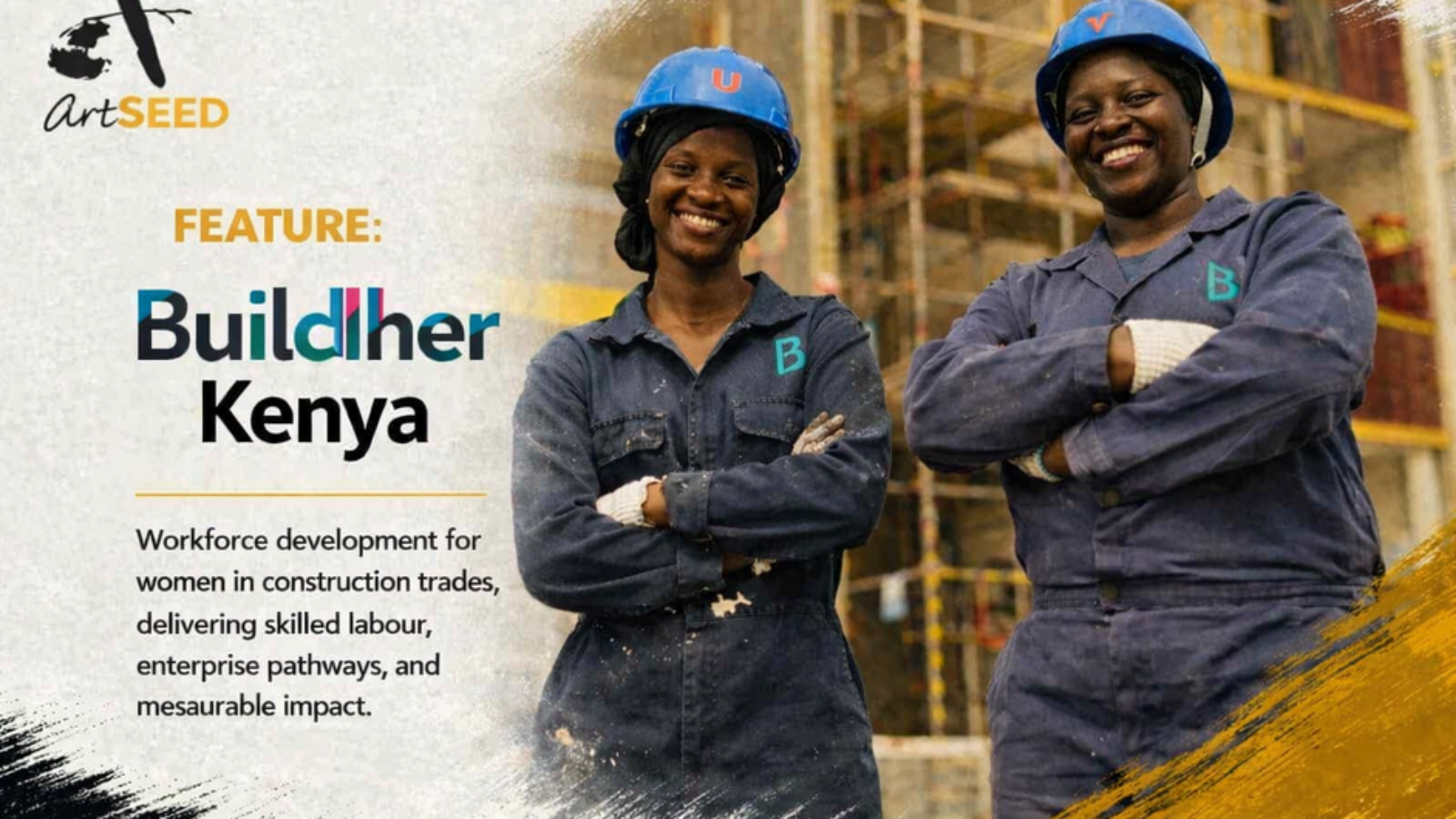
Women make up 3% of Kenya’s accredited construction workforce.
That figure comes from the National Construction Authority. It is not a rounding error. It is a structural reality — one that has persisted in an industry worth over KES 1 trillion and growing at 7% per year, in a country where construction is one of the most visible and consequential sectors of the economy.
Every building going up in Kenya right now was built mostly by men. The tiling, the carpentry, the painting, the finishing trades — the skilled work that determines what a building actually looks and feels like — almost entirely male. Not because women lack the ability. Because the path in was never designed for them.
Buildher Kenya is changing that.
What Buildher Does
Buildher is a Nairobi-based nonprofit founded in 2019 by architect Tatu Gatere. It runs year-long training and internship programmes in carpentry, tiling, painting, and other finishing trades — the skilled craft roles in construction that offer steadier, better-paid work than the informal carrying and labouring positions that most women who enter the sector are confined to.
The model is straightforward. Take women who have been kept out of skilled construction work — by lack of training, by social assumptions, by the simple absence of anyone who looked like them doing the job — and give them the skills, the confidence, and the placement to enter and stay in the industry.
Since 2019, Buildher has trained more than 1,000 women. A 2024 study by Dalberg, a global development advisory firm, found that 65% of graduates were still working in construction twelve months after completing the programme. Their average daily earnings increased five to six-fold within a year of training — from around KES 200 a day to between KES 1,400 and KES 1,500.
These are not small numbers. These are life-changing ones.
The Woman Behind It
Tatu Gatere is an architect. She co-founded Buildher because of what she saw in her own industry.
“I had seen women get stuck in low-paying jobs, and it was like a mental barrier where they couldn’t see the potential right in front of them,” she has said. “So I wanted to help women see that.”
The insight is an architectural one, in a sense. A building is only as good as the people who build it. The detail work — the tiling that determines whether a bathroom feels considered or careless, the carpentry that defines the quality of every fitted surface in a home, the painting that is the final skin of everything you designed — this is skilled work. It requires training, precision, and pride in craft.
Gatere saw that an entire group of people with the capacity for that craft were being systematically excluded from it. And she built a programme to change that.
What It Looks Like in Practice
Diana Ojiambo is 24 years old and works as a machine operator at Furniture International on the outskirts of Nairobi — one of several former Buildher students who have found employment there. She feeds cabinet panels through a PVC edger. Nearby, women sand and assemble cabinetry while a 23-year-old supervisor named Jane Mwangi moves between stations checking measurements and overseeing progress.
Barely a year ago, none of them had worked in the industry. Ojiambo had never worked alongside men before.
“At first, I was very shy,” she says. “I didn’t know how to stand in front of people and speak up. But now I can.”
She is a single mother of two children. She found Buildher through a friend in Kibera, where she lives, when she was unemployed and struggling. Within a year of completing the programme, she is employed, earning significantly more than she was, and already planning to start her own carpentry business.
“Inside this company, some of the men still think we ladies are not fit for this kind of work,” she says. “But if you know what you want, and you believe in yourself, you show them that whatever they can do, you can do better.”
Why This Matters for Architecture
I want to be direct about why I am writing about Buildher in a series that is primarily about architecture and construction practice.
The quality of any building is determined, in significant part, by the quality of the people who build it. The architects who design, the engineers who calculate, the project managers who coordinate — all of us are dependent on the craftspeople who translate drawings into reality. The tiler who works with precision. The carpenter who reads a measurement correctly and cuts to it. The painter who prepares a surface properly before applying a finish.
These people are the final link in the chain between what is designed and what is built. Their skill determines whether the detail in the drawing becomes a detail in the building, or gets lost somewhere between the plan and the wall.
An industry that excludes 97% of the available talent from skilled construction roles is not performing at the level it could. It is not an argument for gender equality as an abstract principle — it is a practical observation about what the industry loses when it closes the door on half the population.
Beyond that: the women Buildher trains are not entering construction to perform a social function. They are entering it because they are good at it, because they need the income, and because the work is there. They are going to be part of Kenya’s construction workforce. The question is whether they are carrying sand or tiling floors.
Buildher is ensuring more of them are tiling floors.
The Bigger Picture
Kenya’s construction sector is valued at over $5.5 billion and growing at 7% per year. The government’s affordable housing programme is targeting 500,000 units. The infrastructure pipeline is substantial. All of this requires skilled labour — enormous amounts of it — over the coming decade.
Buildher is not a small feel-good programme. It is a serious response to a serious gap. The 1,000 women trained since 2019 are a beginning. The model — year-long training, direct internship placement, measurable retention — is one that can scale.
The 3% figure from the NCA is not inevitable. It is a starting point.
Follow Their Work
Buildher Kenya is on Instagram at @buildher_org and at www.buildherkena.org. If you are a contractor, developer, or project manager looking to diversify your construction teams, their placement network is worth knowing about.
If you are a woman considering a career in construction — or know someone who is — this is where to start.
Tag a builder who needs to know about this work.