
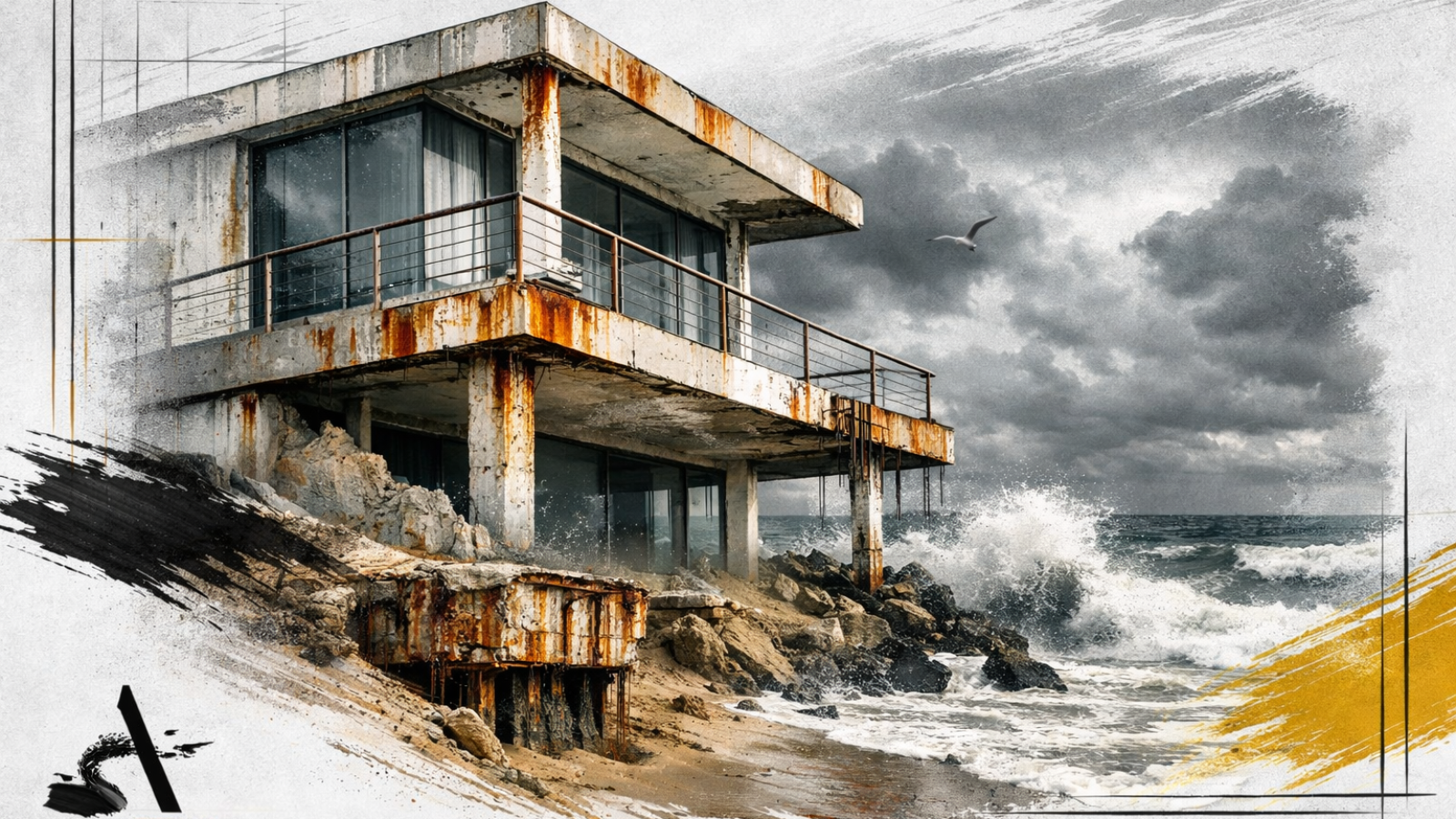
A client called me eight months after moving into their new home in Kilifi.
The taps were rusting. The shower fittings had turned brown. The door handles were corroding at the edges. The house was less than a year old.
They had bought good quality fittings — not cheap ones. They had done their research. They had spent more than they planned to because they wanted things that would last.
The problem wasn’t the quality. The problem was the specification.
What Salt Air Actually Does
The Kenyan coast is beautiful. It is also one of the harshest environments on earth for metal.
Salt air — the moisture-laden air that blows in from the Indian Ocean — carries sodium chloride particles that settle on every surface. When those particles come into contact with metal, they accelerate a process called galvanic corrosion. Essentially, the salt acts as an electrolyte that speeds up the natural breakdown of metal. What would take years inland happens in months at the coast.
It does not discriminate. Chrome fittings. Steel hinges. Aluminium frames. Standard electrical fittings. All of them are vulnerable.
The humidity compounds the problem. Mombasa and Malindi regularly sit above 80% relative humidity. Moisture does not evaporate off surfaces — it sits. Combined with salt particles, you have a relentless chemical process working on your finishes 24 hours a day.
This is not a quality problem. It is a specification problem. And it is entirely preventable.
Standard vs Marine-Grade: What the Difference Actually Means
When you walk into a hardware store in Nairobi and ask for good quality taps, you will be shown chrome-plated brass or stainless steel 304. Both are perfectly adequate for Nairobi. Neither is adequate for the coast.
Here is what you actually need:
Taps and fixtures: Marine-grade stainless steel — grade 316, not 304. The difference is the addition of molybdenum, which dramatically improves resistance to chloride corrosion. Grade 304 rusts at the coast. Grade 316 does not. Most hardware stores in Nairobi do not stock 316. Most clients do not know to ask for it.
Paint: Standard exterior paint formulated for inland conditions will peel and chalk at the coast within two to three years. Coastal-formulated paint contains additional mould inhibitors, has greater elasticity to handle the thermal expansion that comes with coastal heat, and uses binders that resist salt penetration. It costs roughly 20–30% more per litre. It lasts three to four times longer.
Wood finishes: Standard varnish fails in coastal humidity. The finish lifts, moisture gets underneath, and the wood begins to degrade from within. Marine epoxy or oil-based teak finishes — the kind used on boats — are what you need. Again, more expensive upfront. Significantly cheaper over five years.
Electrical fittings: Standard switch plates and socket covers corrode at the coast. Fittings with stainless steel or high-grade plastic faceplates resist salt air better. Junction boxes need to be sealed to a higher standard. Wiring conduits need additional protection.
Door and window hardware: Hinges, handles, locks — all need to be marine-grade or powder-coated to a coastal specification. Standard chrome hardware will show rust within a year.
The Real Cost Comparison
This is where most clients make the mistake. They see the price difference between standard and coastal-specification fittings and choose standard to save money.
Let me show you what that decision actually costs.
Say you are fitting out a 3-bedroom coastal home. Standard chrome taps throughout: roughly KES 45,000. Marine-grade stainless 316 taps: roughly KES 75,000. Difference: KES 30,000.
With standard taps at the coast, you are looking at replacement within 12–18 months. Sometimes sooner. The second set will cost you KES 45,000 again — plus labour to replace, plus the inconvenience, plus the damage to surrounding surfaces from the rust staining. You have now spent KES 90,000 plus and you still do not have fittings that will last.
The marine-grade fittings at KES 75,000 will last eight to ten years with basic maintenance.
The same logic applies across every finish in the house. The cheap option at the coast is always the expensive option when you account for the full lifecycle.
How We Specify at Art Seed
Every project we work on starts with a location assessment before a single material is specified.
Coast and inland are not the same build. They require different material schedules, different engineering considerations, different maintenance protocols. A specification document that works for a project in Karen will not work for a project in Watamu. We do not use the same document for both.
For coastal projects, our material schedule defaults to marine-grade across all metal fittings, coastal-formulated paints and renders, marine finishes for all exposed timber, sealed electrical installations, and powder-coated or stainless hardware throughout.
We also advise clients on what to expect in terms of maintenance schedules. Even marine-grade materials need care in a coastal environment. Rinsing fittings with fresh water periodically, annual checks on paint and render, inspecting seals around windows and doors — these are not complicated tasks, but they make the difference between fittings that last a decade and fittings that fail in two years.
The client in Kilifi had not been told any of this by the team that built their house. They had been sold standard fittings as “good quality” — which they were, for Nairobi. At the coast, they were the wrong specification entirely.
We replaced everything. It cost significantly more than specifying correctly from the start would have.
Before You Build at the Coast
If you are planning a project anywhere along Kenya’s coastline — Mombasa, Malindi, Kilifi, Watamu, Diani, Lamu — here is what I would tell you before you start:
Do not let your contractor or supplier specify materials without explicitly confirming they are appropriate for a coastal environment. “Good quality” is not the same as “coastal-specification.” Ask for the grade. Ask for the brand. Ask if they have used it in a coastal project and how it has held up.
Better still, work with a team that already knows the difference.
Add a Comment