
There is a drawing I made in primary school that my mother kept for years. I don’t remember what it was — a building, a landscape, something I’d seen and wanted to recreate on paper. What I remember is the feeling of making it. The concentration. The satisfaction when it looked right.
I was an artist before I was anything else.
Growing up in Kenya, I competed in Kiwi art competitions. I drew constantly. I had the kind of mind that needed to make things — to take what existed in my head and put it somewhere real. My father was a contractor, so I also grew up around construction sites. I understood materials. I understood how things were built. I watched walls go up and roofs go on and spaces take shape from nothing.
But architecture? That was never the plan.
The Accident
When it came time to apply for university, I had a course in mind. A different one entirely. I don’t talk about it much — it doesn’t matter now — but architecture was not it. I applied. I didn’t make the cut.
So I ended up in architecture almost by default.
I remember thinking it was a setback. A detour. Something I would get through and then figure out what came next. What I didn’t expect was that the moment I started drawing spaces — not pictures, but spaces — something shifted.
Architecture is not like other disciplines. It is not purely technical and it is not purely creative. It sits right at the intersection of both. You are solving problems that are part structure, part logic, part human feeling. You are asking: how will this space make someone feel? Where will the light fall in the morning? How will a family move through this place at 7am when everyone is rushing and the kitchen needs to work?
These were the kinds of questions I had been asking my whole life without knowing it. Not in buildings — in drawings. In the way I composed things on paper. In the way I noticed what felt balanced and what felt wrong.
Architecture didn’t feel like a backup plan for long.
What a Teacher Saw
Years before I ended up in architecture — years before university — a teacher told me I would make a good architect.
I didn’t believe her.
I was a teenager. I knew I liked art. I knew I was good at drawing. But architecture seemed like something else entirely. Something more serious, more technical, more certain than I felt about anything at that age. I filed it away and forgot about it.
She was right. It took me a while to catch up to what she already saw.
That is the strange thing about people who know you before you know yourself. They see the pattern before you do. They see the way your mind works — the way you look at things, the way you notice what others don’t — and they can sometimes name it before you can.
I think about that teacher more than she probably knows.
What the Art Taught Me
People sometimes ask me what architecture and art have in common. I think they are asking the wrong question. The better question is: what does an artistic way of thinking bring to architecture that pure technical training doesn’t?
The answer, for me, is observation.
Artists look at things differently. They notice proportion. They notice how light changes a surface. They notice what draws the eye and what feels out of place. They are trained — or they train themselves — to see before they act.
That habit of seeing is something I bring to every project.
When I visit a site for the first time, before I draw a single line, I observe. Where does the sun rise? Where does the wind come from? What does the landscape want to do? In Malindi, where I am based, the coast has its own logic — the salt air, the humidity, the way the breeze moves through the afternoon. A building that fights that logic will lose. A building that works with it will last.
This is not a technical insight. It is an artistic one. My design philosophy — simplicity, natural materials, spaces that respond to their environment — comes directly from the way I was trained to look at the world long before I became an architect. Less is more is not a rule I follow. It is how I see.
Where It Led
I have been an architect for seven years. I have worked on projects at scale — the JKIA terminal expansion, interiors at Two Rivers Mall — and I have led projects that started as a conversation with a couple about their dream home and ended with a building that surprised all of us.
Three years ago, I started Art Seed Limited. A design-build firm — which means we don’t just draw buildings and hand them off. We design them, engineer them, and build them. One team, one accountability, from the first conversation to the moment the key is handed over.
I started it because I was tired of the gap between what gets designed and what gets built. And because I wanted to work in a way that felt true to how I think — where the design and the construction are not two separate worlds but one continuous act of making.
Kenya has a building culture that leans heavily on imitation. Drive through any city and you will see the same blocks, the same layouts, the same finishes — rearranged but not reimagined. I understand why. Safe is predictable. Predictable is easier to sell.
But architecture should do more than that. It should respond to where it is — to the climate, the soil, the way people in this place actually live. It should be simple enough to be timeless and specific enough to be honest.
That is what I am trying to build. One project at a time.
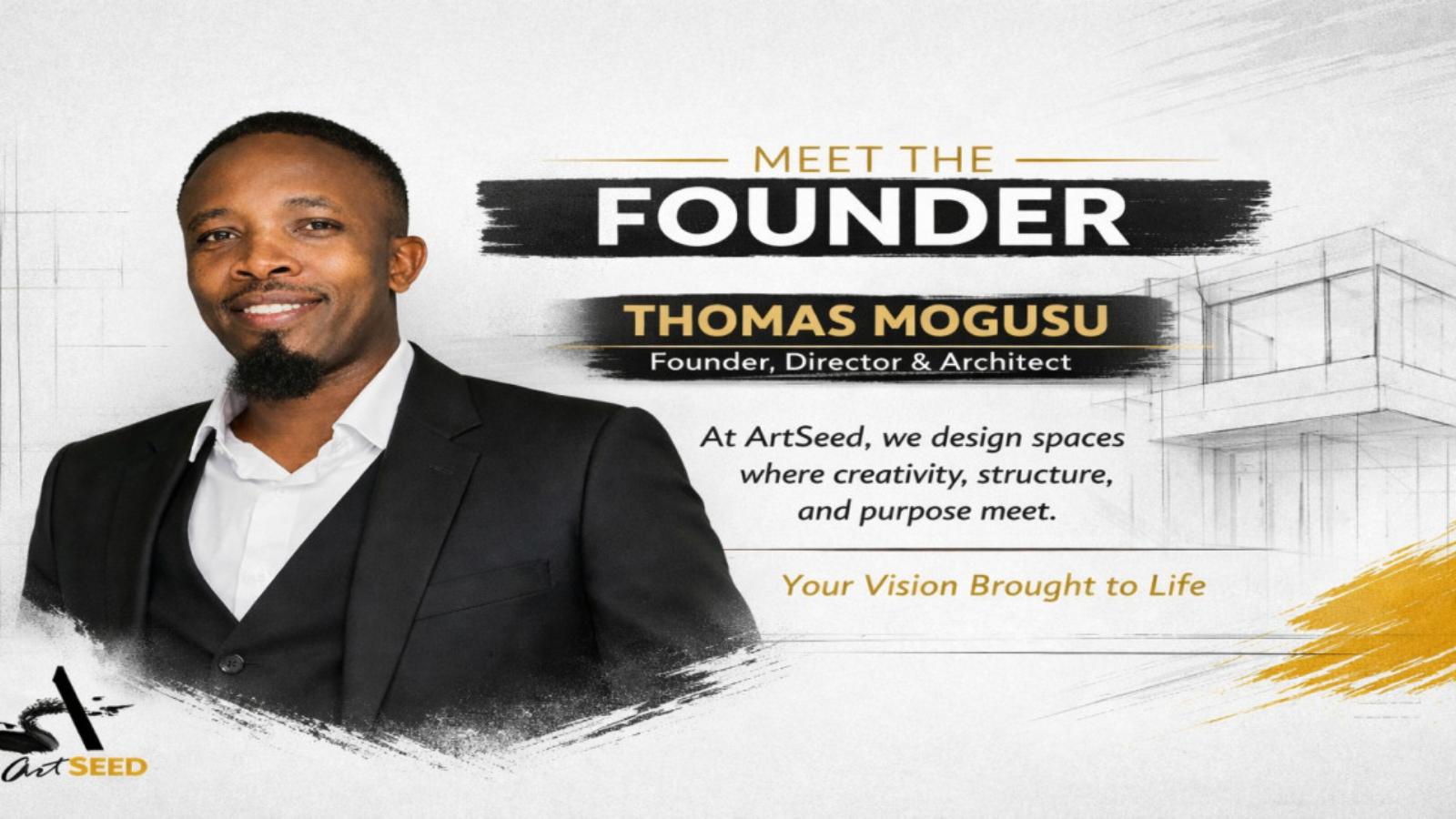
Thomas Mogusu is the Director and Architect at Art Seed Limited, a design-build firm based in Malindi, Kenya. Art Seed provides integrated architecture, engineering, and construction services across Kenya.
📧 mogusu@artseed.co.ke | 📞 +254 703 148492 | 🌐 www.artseed.co.ke
Add a Comment