
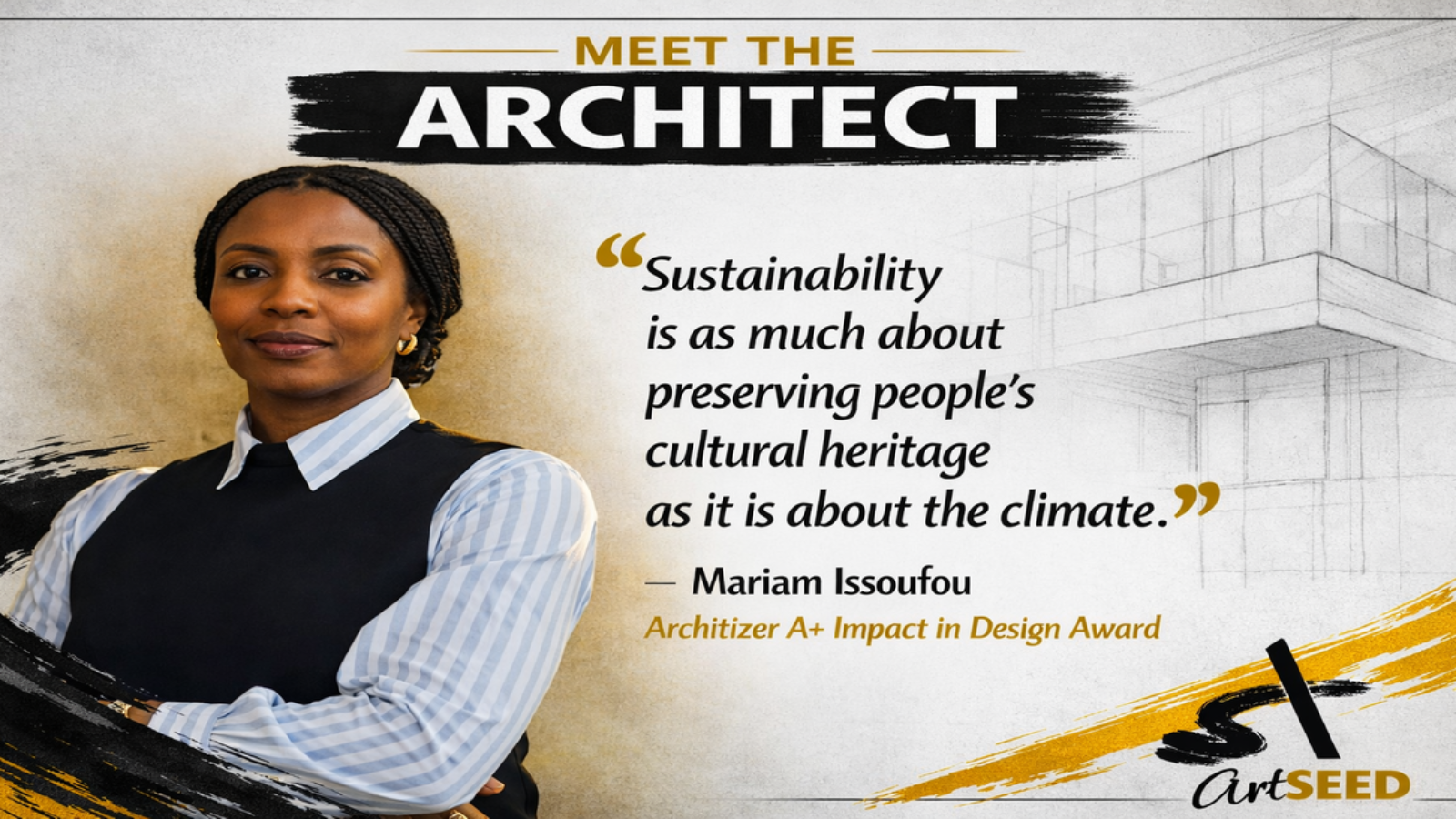
When Mariam Issoufou was six years old, her family moved from Niamey to Agadez — an ancient city on the edge of the Sahara Desert in Niger.
She remembers coming home from school in the blazing heat and stepping into the mud vestibule of their house. The temperature dropped so dramatically that she would shiver.
That experience stayed with her. Decades later, it is still the foundation of everything she builds.
She has described it plainly: it drove home to her the importance of choices in the way we create our spaces.
This is what climate-responsive architecture looks like when it comes from lived experience rather than theory. Not a technical specification added to a drawing. A fundamental understanding — felt in the body — of what buildings can do for the people inside them.
The Long Way to Architecture
Issoufou spent the first part of her working life as a software developer in New York. She had studied computer science at Purdue and earned a master’s degree from New York University. She worked in tech for nearly a decade.
Then she went back to architecture — the dream she had carried since childhood, since those mud-brick walls in Agadez had shown her what a building could do.
After graduating with a master’s in architecture from the University of Washington, she returned to Niamey — a city largely shaped by colonial architecture ill-adapted to its current culture and environment. She founded her practice, originally called atelier masōmī and now Mariam Issoufou Architects, in Niamey in 2014, with studios subsequently established in New York and Zurich.
The detour through software is not incidental to understanding her work. It shaped how she thinks: systematically, with attention to the logic behind decisions, and with an engineer’s understanding that every choice has consequences that compound over time. Her buildings are not intuitive gestures. They are argued positions.
What She Builds With
Her most celebrated project is the Hikma Community Complex in Dandaji, Niger — a library and mosque complex completed in 2018 that won two Global Holcim Awards for sustainable architecture. The complex uses compressed earth bricks, natural ventilation, and a design that allows the secular and the religious to coexist in the same space. A library and a mosque, side by side, both serving the same community.
The building is an architectural riddle. Sleek and modern but forged from traditional clay bricks, it both stands out and blends into the austere, semi-arid landscape that surrounds it.
Her residential project Niamey 2000 addressed the housing crisis in Niger’s capital without reaching for concrete high-rises. Made of compressed earth bricks — which she calculated to be around 30% cheaper than concrete and naturally cooler — the project uses communal areas that foster intergenerational living while maintaining privacy. It was shortlisted for the Aga Khan Award for Architecture in 2022.
The material logic here is worth sitting with. Compressed earth bricks are cheaper than concrete, cooler by nature, locally sourced, and carry the cultural memory of the place they are built in. The argument for using them is not sentimental. It is economic, environmental, and functional simultaneously.
This is what serious sustainable architecture looks like. Not greenwashing. Not a solar panel added to an otherwise standard building. A fundamental rethinking of what you build with and why.
The Recognition
In 2025, the United Nations Environment Programme named Mariam Issoufou a UN Champion of the Earth — one of the highest environmental honours — recognising her decade-long career focused on helping communities adapt to a changing climate and extreme heat.
Also in 2025, she designed the Rolex Pavilion for the Venice Architecture Biennale. The wooden facade was made from 200-year-old Venetian Palazzi wood beams, repurposed and transformed into walls — a building about local production and craft, built from local materials, for one of architecture’s most visible global stages.
She is currently a full professor of Architecture Heritage and Sustainability at ETH Zurich, and has active projects under construction in Senegal and Liberia.
Why Her Work Matters Here
I write about architects whose work says something relevant to what we are trying to do in Kenya. Mariam Issoufou’s work says several things at once.
The first is about materials. She has built a career around the argument that local materials — earth, clay, compressed brick — are not second-best options. They are often the most intelligent choice: cheaper, better suited to the climate, lower in embodied carbon, and connected to the architectural heritage of the place. Her architecture always reflects the place it is for.
In Kenya, we have a persistent tendency to import both materials and aesthetics from contexts that have nothing to do with ours. Glass curtain walls in Nairobi. Chrome fittings at the coast. Construction methods developed for European climates applied wholesale to the equatorial zone. These choices are not wrong because they are foreign. They are wrong because they are inappropriate — and inappropriateness always reveals itself eventually, in maintenance costs, in comfort failures, in buildings that age badly and quickly.
The second thing her work says is about what happens when you design from the inside out — from the experience of the people who will live in a space, from the climate conditions of the place, from the materials that actually exist in the context. She has spoken about bringing traditional craftsmanship back into the building value chain not as nostalgia but as practical intelligence.
At Art Seed, this is the conversation we are trying to be part of in Kenya. Not at the scale Issoufou operates — she is one of the most recognised architects in the world right now — but with the same underlying logic. Natural materials. Climate-responsive design. Buildings that fit where they are built, not where they were imagined.
The third thing is simpler: she came to architecture after doing something else entirely, founded a practice in a place with significant constraints, and built a body of work that is now on display at the Venice Biennale and recognised by the United Nations.
The path is not always direct. The work is what counts.
Follow Her Work
Mariam Issoufou Architects is on Instagram at @mariamissoufouarchitects and at www.mariamissoufou.com. Her work is extensively documented on ArchDaily, Dezeen, and in a recent AramcoWorld profile.
Tag an architect or builder who needs to know this work.