
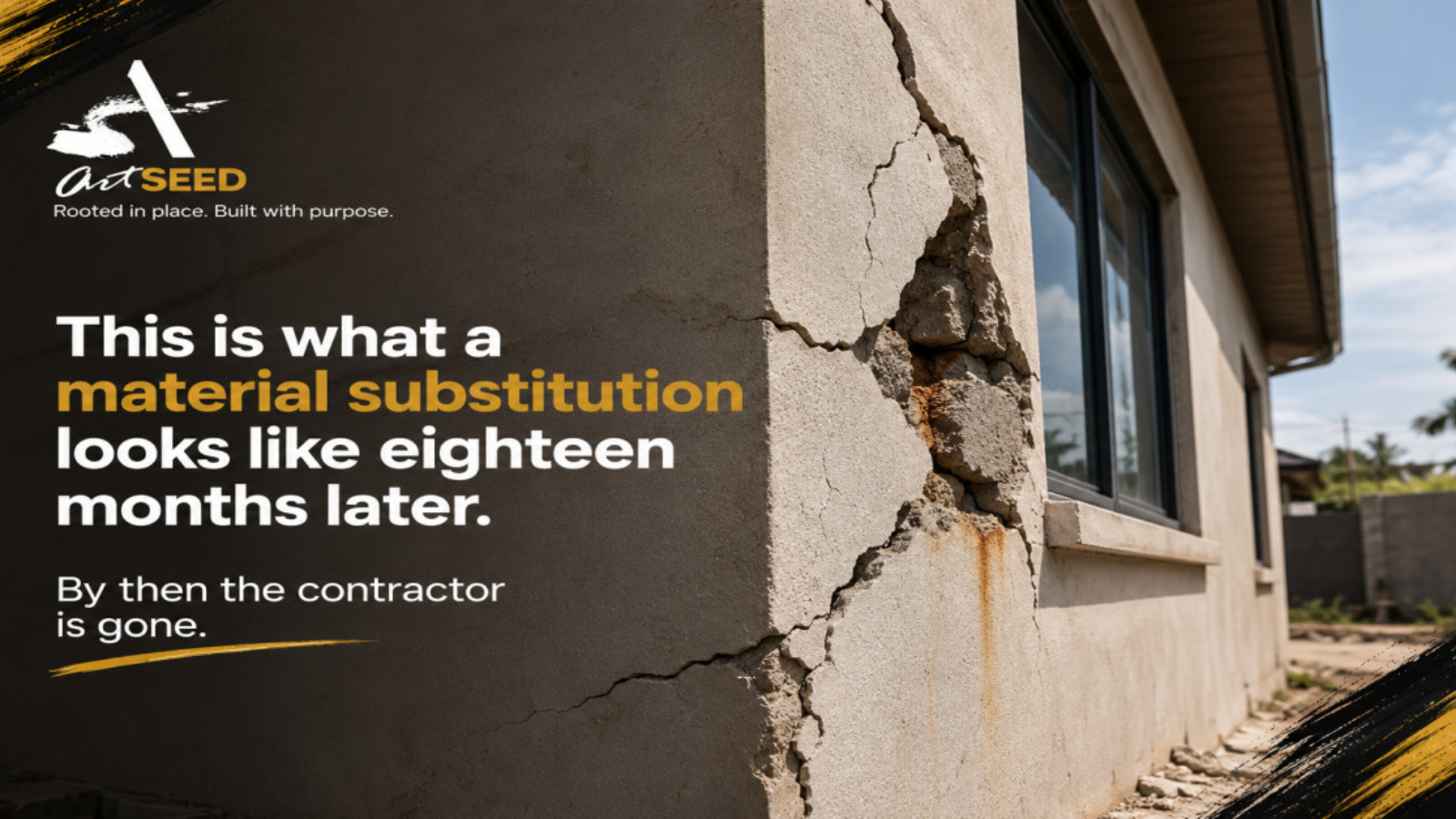
Most construction problems do not announce themselves. They arrive quietly — a crack that appears eighteen months after handover, a roof that leaks in the second rainy season, a floor finish that starts lifting two years in. By the time the problem is visible, the contractor is long gone and the cost of fixing it lands entirely on the owner.
The problems rarely come from nowhere. They come from decisions made on site while the client was not looking. Small substitutions, gradual timeline slippage, materials that looked similar to what was specified but were not. The kind of changes that are easy to miss if you do not know what to look for.
Here is what to look for.
Material Substitution
This is the most common and the most costly red flag on a Kenyan construction site.
It works like this. Your contract specifies a particular cement brand — one with a proven compressive strength record in your climate and for your foundation type. Midway through the project, that brand is temporarily unavailable, or the contractor finds a cheaper alternative, or the supplier they use stocks something different. They make the switch without telling you. The work continues.
You do not find out until the foundation starts cracking eighteen months later.
This is not a hypothetical. It is a pattern that repeats itself across construction sites in Kenya, and the reason it keeps happening is that most clients cannot tell the difference between cement brands by looking at the bags on site. They trust that what was specified is what is being used. That trust is sometimes misplaced.
Cement is not the only material at risk. Steel grade substitution is equally common and equally dangerous. The difference between Y12 and Y10 reinforcement bar is not visible once the concrete is poured. It is visible when the structure is under load. Roofing materials, waterproofing membranes, timber grades — all of these get substituted on projects where nobody is checking.
The phrase to listen for is: same quality, cheaper price. That phrase is doing a specific job. It is pre-empting your objection before you have made it, and it is not true. If it were the same quality at a cheaper price, the specified material would not exist. Materials are priced according to what they do. A cheaper material is cheaper for a reason, and that reason will show up somewhere in the building’s performance, on a timeline you cannot predict at handover.
What “Temporary” Means on a Construction Site
Contractors who substitute materials rarely describe it as a permanent change. It is always temporary. The specified brand will be available next week. This alternative is just for the foundation pour — the rest will be done correctly. They will sort it out.
Temporary changes on construction sites have a way of becoming permanent. The alternative brand arrives, the pour happens, the next phase begins, and the substitution is never reversed because there is no mechanism to reverse it — the concrete is already cured.
The time to catch a material substitution is before the material is used, not after. Once it is in the building, the options are expensive: accept it, or open up the structure to verify and replace. Neither is what you wanted to be dealing with at that stage of the project.
Timeline Slippage
Timeline slippage is the second red flag, and it is one that clients often dismiss too easily.
A contractor who is consistently behind programme is telling you something. Not always that they are dishonest — sometimes it is capacity, sometimes it is supplier delays, sometimes it is genuine site conditions. But consistent slippage without explanation or recovery plan is a signal that the project is not being managed to a standard that protects your interests.
The pattern to watch for is this: the contractor falls behind, offers a reason, catches up partially, falls behind again. Each individual delay seems manageable. The cumulative effect is a project that runs two or three months over programme, absorbing supervision costs, extended equipment hire, and in some cases material price escalation on items that were not procured early enough.
Timeline slippage also creates pressure that produces shortcuts. A contractor who is behind schedule and under financial pressure to complete is a contractor who may start making decisions — about curing times, about quality checks, about the sequence of work — that prioritize speed over correctness. Those decisions do not show up at handover. They show up later, in the building’s performance.
The Curing Time Problem
One of the least visible shortcuts on a construction site is insufficient curing time for concrete.
Concrete does not reach its design strength immediately after pouring. It cures over time — the standard minimum for most structural applications is 28 days of adequate moisture and temperature conditions. A contractor who is under schedule pressure may strip formwork early, load the structure before it has reached adequate strength, or move to the next phase before the previous one has properly cured.
You cannot see this happening. The concrete looks fine. The problem emerges later, under load, over time, in ways that are difficult to trace back to the original cause by the time they become visible.
This is why supervision matters. Not inspection at the end — supervision throughout. Someone on site, or visiting site regularly, who knows what the curing schedule should be and can verify that it is being followed.
What Supervision Actually Means
Clients who manage their own construction projects without professional supervision are managing risk they cannot always see.
A quantity surveyor or clerk of works visiting site regularly is not an added cost on top of the project. They are the mechanism by which the project is built to the specification that was contracted. They check material deliveries against what was specified. They track programme against the baseline schedule. They catch substitutions before they become part of the building. They maintain a site record that is evidence of what was done and when — which matters if a dispute arises later.
At Art Seed, the design-build model means the team that designed the project is the same team supervising its construction. There is no gap between what was intended and what is being checked on site. When a material arrives that does not match the specification, the person who wrote the specification is the person who catches it.
That is not the only way to manage a project. But some version of professional supervision is not optional on a project of any meaningful size. The alternative is trusting that every decision made on site while you are not there is the right one.
Some of them will be. Not all of them.
Know What to Check
You do not need to be an architect or a quantity surveyor to catch the most common red flags on your project. You need to know what was specified and be present enough to verify that it is what is being used.
Check material deliveries. Ask to see the delivery notes and compare the brand and grade to what your contract specifies. If it does not match, ask why before it goes into the building.
Track the programme. If the contractor is behind, ask for a recovery plan in writing. A plan that exists only verbally is not a plan.
Ask about curing times. When was this poured? When will you strike the formwork? The answers should match the specification. If they do not, you want to know before the next pour.
The problems that cost the most are the ones that were visible on site and missed. You do not have to miss them.
Know what to check — or hire someone who does.